


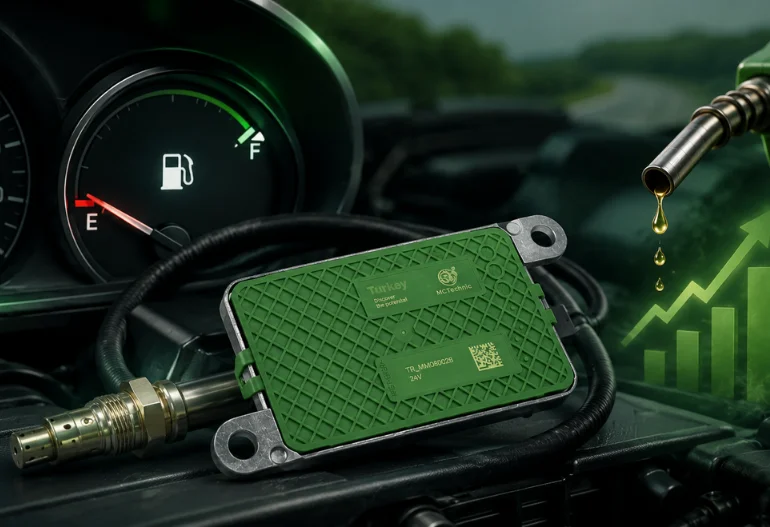
In modern vehicle technologies, emission control systems play a critical role in terms of engine performance and environmental standards. The NOx sensor, especially used in diesel-powered vehicles, measures the level of nitrogen oxides in exhaust gases and provides data to the vehicle’s emission management system. This data is highly important for the SCR system, AdBlue usage, engine control unit, and exhaust aftertreatment processes.
A NOx sensor failure should not be considered merely a simple sensor problem. A faulty or inaccurately measuring NOx sensor can directly affect engine performance, fuel consumption, the AdBlue system, exhaust emission values, and the overall operating efficiency of the vehicle. Therefore, early detection of symptoms, accurate fault diagnosis, and the use of high-quality sensor solutions are important for vehicle owners, service providers, and fleet managers.
What Does a NOx Sensor Do?
A NOx sensor is an advanced automotive sensor located in the exhaust system of a vehicle that measures the level of nitrogen oxide gases. NOx refers to nitrogen oxide compounds formed at high combustion temperatures. Since these gases are harmful to the environment and human health, they are managed through emission control systems in modern vehicles.
The NOx sensor measures the nitrogen oxide level in the exhaust gas and transmits this information to the engine control unit. The engine control unit evaluates this data and optimizes the SCR catalyst, AdBlue injection system, and exhaust gas aftertreatment process. As a result, the vehicle operates more in line with legal emission standards and contributes to reducing environmental impact.
Why Is NOx Sensor Failure Important?
When a NOx sensor fails, the vehicle cannot accurately measure the nitrogen oxide level in the exhaust gas. This may cause the engine control unit to operate based on incorrect data. Faulty data can lead the emission system to work either more than necessary or insufficiently.
In vehicles equipped with an SCR system, the NOx sensor is one of the key components required for the system to function correctly. Sensor failure may result in irregular AdBlue consumption, the engine warning light coming on, reduced performance, increased fuel consumption, and the vehicle entering protection mode.
Therefore, a NOx sensor failure is not only a comfort-related issue. It is also a technical fault that should be taken into consideration in terms of operational cost, environmental compliance, legal emission standards, and engine health.
How to Recognize a NOx Sensor Failure
A NOx sensor failure often reveals itself through warnings on the vehicle’s dashboard. However, in some cases, the symptoms may appear gradually. For this reason, changes in vehicle performance, increases in fuel consumption, and warnings related to the AdBlue system should be monitored carefully.
During fault diagnosis, relying only on the dashboard warning may not be sufficient. Fault codes must be read using professional service equipment, live data values should be examined, SCR system performance must be checked, and sensor connections should be evaluated. In some cases, the problem may not be directly caused by the NOx sensor but by cable connections, exhaust leaks, the AdBlue system, or the SCR catalyst.
The Most Common Symptoms of NOx Sensor Failure
1. Engine Warning Light Comes On
One of the most common symptoms of NOx sensor failure is the engine warning light turning on. When the vehicle’s control unit detects incorrect, missing, or inconsistent data from the sensor, it may generate a fault record. In this case, an engine warning light or emission system warning may appear on the dashboard.
This warning should not be ignored. If early intervention is not carried out, the issue may also affect other components of the emission system.
2. AdBlue Warning Appears
In vehicles equipped with an SCR system, the NOx sensor helps manage AdBlue usage correctly. When the sensor fails, the system may not accurately measure the NOx level in the exhaust gas. As a result, warnings such as AdBlue failure, emission system warning, or system error despite sufficient AdBlue may appear.
It should be remembered that an AdBlue warning is not always caused by a lack of fluid. Different issues related to the NOx sensor, AdBlue pump, injector, level sensor, crystallization, or SCR system may also cause this warning.
3. Increased Fuel Consumption
A malfunctioning NOx sensor may send incorrect data to the engine control unit. This can negatively affect the engine’s combustion strategy, air-fuel ratio, and emission control process. As a result, fuel consumption may increase.
Especially in commercial vehicles, heavy-duty vehicles, and fleet vehicles, even small increases in fuel consumption can create significant long-term costs. Therefore, when unexpected fuel consumption increases occur, the NOx sensor and emission system should be checked.
4. Decrease in Engine Performance
A NOx sensor failure may cause a noticeable decrease in vehicle engine performance. Symptoms such as loss of traction, delayed acceleration, reduced torque, lack of response at higher RPMs, or general performance weakness may be observed.
When the engine control unit detects that emission values cannot be managed properly, it may limit engine power. This directly affects operational efficiency, especially in long-distance vehicles, load-carrying commercial vehicles, and heavy-duty vehicles.
5. Vehicle Enters Limp Mode / Protection Mode
As a NOx sensor failure progresses, some vehicles may enter protection mode. This mode limits the vehicle’s performance in order to protect the engine and emission system. In this case, the driver may notice that the vehicle does not accelerate properly, engine power decreases, or the vehicle has difficulty exceeding a certain speed.
Protection mode is a serious warning that should not be ignored. At this stage, the vehicle must be checked using professional diagnostic equipment.
6. Increased Exhaust Emission Values
When the NOx sensor does not measure correctly, the SCR system and exhaust aftertreatment process may not operate efficiently. This may lead to increased exhaust emission values. Problems during emission inspection, non-compliance with environmental standards, or high NOx values in exhaust gas measurements may indicate this issue.
7. Irregular AdBlue Consumption
A faulty NOx sensor can indirectly affect the AdBlue injection process. In some cases, the vehicle may consume more AdBlue than necessary, while in other cases, the system may not provide sufficient dosing. Both scenarios reduce the efficiency of the SCR system.
If abnormal AdBlue consumption or system warnings are observed, the NOx sensor, AdBlue pump, injector, and SCR catalyst should be evaluated together.
Why Does a NOx Sensor Fail?
NOx sensors operate under high temperatures, intense exhaust gas flow, and demanding working conditions. Therefore, wear may occur over time. The main causes of failure may include exposure to high heat, soot and carbon buildup, moisture, cable connection issues, socket oxidation, vibration, exhaust leaks, electronic circuit failures, and the use of low-quality parts.
In addition, previous problems related to the DPF, SCR, AdBlue, or exhaust system may also affect the operating performance of the NOx sensor. For this reason, fault diagnosis should be carried out by evaluating the system as a whole.
What Should Be Done in Case of NOx Sensor Failure?
If a NOx sensor failure is suspected, professional fault diagnosis should be performed first. Fault codes should be read, live sensor data should be examined, cable and socket connections should be checked, possible exhaust leaks should be evaluated, and SCR system performance should be analyzed.
Before directly replacing the sensor, the source of the problem should be clearly identified. In some cases, the fault may not be caused by the sensor itself but by another component in the system. However, if it is confirmed that the sensor is measuring incorrectly or not functioning, it should be replaced with a high-quality and compatible NOx sensor.
Advantages of Using a High-Quality NOx Sensor
The NOx sensor is one of the strategic components of a vehicle’s emission management system. Therefore, quality, compatibility, durability, and measurement accuracy are highly important when selecting a sensor.
A high-quality NOx sensor accurately measures the nitrogen oxide level in the exhaust gas, transmits correct data to the engine control unit, supports the efficient operation of the SCR system, optimizes AdBlue consumption, helps maintain engine performance, and may reduce long-term maintenance costs.
Especially in heavy-duty vehicles, commercial vehicles, fleet vehicles, and vehicles used intensively, reliable sensor technologies are critical for operational continuity.
Reliable NOx Sensor Solutions with MCT Technic
At MCT Technic, we offer solutions in NOx sensor technologies with a focus on high accuracy, durability, and environmentally friendly engineering. The NOx sensors we develop are designed to contribute to emission management, engine performance, fuel efficiency, and sustainable transportation goals.
In our products, we prioritize measurement accuracy, long service life, resistance to demanding operating conditions, user-friendly installation, and high-quality standards. As MCT Technic, we continue to develop innovative and reliable sensor technologies that meet the changing needs of the automotive industry.
Frequently Asked Questions
How can a NOx sensor failure be recognized?
A NOx sensor failure is generally recognized through symptoms such as the engine warning light, AdBlue warning, increased fuel consumption, reduced performance, increased exhaust emission values, and the vehicle entering protection mode.
Can a vehicle be driven with a faulty NOx sensor?
Although the vehicle may seem usable for a short period, ignoring the fault may negatively affect engine performance, the emission system, and AdBlue management. Therefore, professional inspection is recommended as soon as possible.
Does a NOx sensor failure increase fuel consumption?
Yes. Incorrect data sent by the NOx sensor may affect the engine control strategy. This can lead to increased fuel consumption and performance loss.
Does a NOx sensor failure affect the AdBlue system?
Yes. The NOx sensor is directly connected to the SCR and AdBlue systems. Incorrect measurement may cause improper AdBlue dosing or system warnings.
Why does a NOx sensor fail?
High temperature, soot buildup, moisture, cable connection problems, socket oxidation, vibration, exhaust leaks, and the use of low-quality sensors may cause NOx sensor failure.
What should be considered when replacing a NOx sensor?
The sensor must be compatible with the vehicle, provide accurate measurement precision, have a durable structure, and be manufactured according to high-quality production standards. Before replacement, the source of the fault should be professionally verified.
Contact MCT Technic
For detailed information about NOx sensor failure, emission control technologies, and automotive sensor solutions, you can contact the expert team at MCT Technic.
MCT Technic Sensor Inc.
Address: Yeşilköy SB Mahallesi, Istanbul Specialized Free Zone, İşbi Plaza No: 4/1, 34149 Bakırköy / Istanbul
Phone: +90 533 600 99 42
E-mail: info@mctsensor.com
Contact us for NOx sensor technologies, SCR systems, AdBlue management, and exhaust emission control solutions, and receive professional support for the most suitable solution for your needs.

