


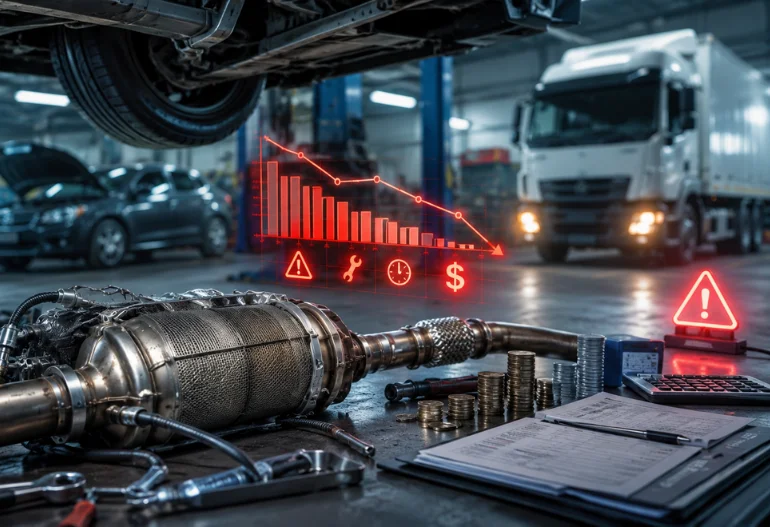
In the automotive industry, emission control technologies are critical not only for complying with environmental standards but also for maintaining vehicle performance, improving fuel efficiency, managing operating costs, and ensuring operational continuity. One of the most important components of these systems is the NOx sensor, which measures the level of nitrogen oxides in the exhaust gas and provides data to the engine control unit.
However, making a NOx sensor selection based only on price can lead to serious long-term costs for vehicle owners, service providers, fleet managers, and businesses. Low-quality, incompatible, or low-precision NOx sensors may cause incorrect measurements, repeated failures, increased fuel consumption, AdBlue system problems, SCR inefficiency, performance loss, and higher maintenance costs.
For this reason, the NOx sensor should not be considered a simple spare part. It should be evaluated as a strategic component that directly affects the vehicle’s emission control system, engine performance, and total cost of ownership.
Why Is the NOx Sensor a Critical Component?
The NOx sensor is an advanced automotive sensor located in the exhaust line of vehicles and measures nitrogen oxide gases. Especially in diesel-powered vehicles, nitrogen oxide components such as NO and NO₂ are formed during the combustion process and are among the harmful gases that must be controlled for environmental and human health reasons.
In modern vehicles, the NOx sensor works in integration with the SCR system, AdBlue dosing, engine control unit, exhaust gas aftertreatment process, and emission management system. Accurate data from the sensor helps the vehicle keep emission values within legal limits, operate the engine more efficiently, and reduce environmental impact.
A high-quality NOx sensor performs precise measurements, works in harmony with the system, and withstands demanding exhaust conditions. A low-quality sensor, on the other hand, may negatively affect this entire chain.
What Does a Low-Quality NOx Sensor Mean?
A low-quality NOx sensor generally refers to sensors with poor measurement accuracy, limited compatibility with the vehicle system, insufficient resistance to high temperature and vibration conditions, weak electronic board quality, or limited long-term performance.
Such sensors may appear to be more affordable at first. However, if they fail in a short time, produce incorrect data, or operate incompatibly with the system, the total cost can increase rapidly. Choosing a cheap part often creates additional burdens such as repeated service visits, part replacement, labor costs, vehicle downtime, and customer dissatisfaction.
Therefore, when choosing a NOx sensor, the focus should not be only on the purchase price. Product quality, measurement accuracy, warranty support, production standards, vehicle compatibility, and technical reliability must also be considered.
Incorrect Measurement Can Affect the Entire Emission System
The main function of a NOx sensor is to provide accurate measurement. A low-quality sensor may incorrectly read the nitrogen oxide level in the exhaust gas. Since the engine control unit makes decisions based on this faulty data, the SCR system, AdBlue injection, and emission aftertreatment process may be managed incorrectly.
This may cause the vehicle to consume more AdBlue than necessary, perform insufficient emission treatment, or trigger the engine warning light. In some vehicles, emission system faults may cause the vehicle to enter protection mode and limit engine power.
In other words, a low-quality NOx sensor does not only create a fault on its own; it may also affect other components in the vehicle’s emission control system in a chain reaction.
Impact on Fuel Consumption and Performance
NOx sensor failures may have a direct or indirect impact on fuel consumption. Faulty data from the sensor may cause the engine control strategy to operate inefficiently. In addition, when the vehicle experiences performance loss, the driver may press the accelerator more to achieve the same traction. This can lead to increased fuel consumption.
In vehicles using low-quality NOx sensors, symptoms such as reduced traction, weak acceleration, low torque feeling, engine warning light, AdBlue warning, and exhaust emission system faults may occur. Especially in heavy-duty vehicles, trucks, buses, light commercial vehicles, and fleet vehicles, such problems directly increase operating costs.
Even a small increase in fuel consumption in a single vehicle can turn into serious financial losses on a monthly and annual basis in large fleets. Therefore, choosing a high-quality NOx sensor is not only a technical decision but also an economic one.
Vehicle Downtime Is a Major Cost for Businesses
For commercial vehicles and fleet vehicles, one of the biggest costs is vehicle downtime. When a vehicle fails due to a low-quality NOx sensor, the cost is not limited to part replacement. The vehicle also remains in service, deliveries may be delayed, operational planning may be disrupted, and the company’s service capacity may decrease.
Especially in logistics, transportation, distribution, public transport, construction, municipal services, and shuttle operations, keeping vehicles active is critical for operational efficiency. Repeated failures caused by a low-quality sensor can create time loss, revenue loss, and customer satisfaction risks for businesses.
Therefore, reliability, durability, and long service life in NOx sensor selection provide businesses with a direct cost advantage.
Repeated Failures Affect Service Quality and Customer Satisfaction
Low-quality NOx sensors are not only a risk for vehicle owners but also for service providers and spare parts suppliers. Sensors that do not operate compatibly or fail in a short time may cause customers to return to the service center repeatedly. This increases service workload, reduces customer trust, and creates problems in warranty processes.
For professional service providers, selecting the right product is an important part of service quality. Using a high-quality and reliable NOx sensor reduces repeated failures, strengthens customer satisfaction, and supports more efficient service operations.
Risks on the AdBlue and SCR System
The NOx sensor is directly connected to the SCR system and AdBlue dosing process. When a low-quality sensor performs incorrect measurements, the AdBlue system may operate more than necessary or insufficiently. This creates imbalance in AdBlue consumption and may prevent the SCR catalyst from operating efficiently.
Inefficiency in the SCR system may cause exhaust emission values to rise, the engine control unit to register faults, and the vehicle to become non-compliant with emission standards. In addition, faults related to the AdBlue system may lead to unnecessary part replacements if diagnosed incorrectly.
For this reason, NOx sensor quality is important not only for sensor performance but also for the overall health of the entire exhaust emission system.
Why Should Total Cost of Ownership Be Considered?
The real cost of a spare part is not limited to its purchase price. Total cost of ownership includes part price, labor, service time, repeated failure, fuel consumption, vehicle downtime, warranty processes, and operational losses.
A low-quality NOx sensor may seem more economical at first. However, due to short service life, incorrect measurement, repeated replacement, performance loss, and system failures, it may create higher long-term costs. A high-quality sensor supports longer performance, more accurate measurement, lower failure risk, and more reliable emission management, helping keep total costs under control.
What Should Be Considered When Choosing a High-Quality NOx Sensor?
When selecting a NOx sensor, vehicle compatibility, measurement accuracy, high-temperature resistance, electronic component quality, production standards, serial number tracking, warranty support, and technical reliability should be considered.
In addition, during installation, the AdBlue system, connection equipment, sockets, cables, exhaust line, SCR catalyst, and system compatibility should be checked. Even if the correct sensor is used, faulty installation or another problem in the system may negatively affect sensor life.
Professional fault diagnosis and correct product selection should be evaluated together for long-term efficiency.
Reliable NOx Sensor Solutions with MCT Technic
At MCT Technic, we develop NOx sensor technologies with a focus on high accuracy, durability, and environmentally friendly engineering. Our products are designed to contribute to exhaust gas measurement accuracy, SCR system compatibility, AdBlue management, engine performance, and emission control processes.
MCT Technic NOx sensors support vehicles in operating more efficiently, reliably, and sustainably with their resistance to demanding operating conditions, precise measurement capability, and quality-focused production approach. From passenger cars to light commercial vehicles, from heavy-duty vehicles to fleet solutions, we aim to add value to emission control systems across different areas of use.
Choosing a high-quality NOx sensor means lower failure risk, more controlled fuel consumption, less vehicle downtime, stronger customer satisfaction, and more sustainable operations for businesses.
Frequently Asked Questions
Can a low-quality NOx sensor damage the vehicle?
Yes. A low-quality or incompatible NOx sensor may negatively affect the SCR system, AdBlue dosing, engine control unit, and exhaust emission management by performing incorrect measurements. This may cause performance loss, increased fuel consumption, and repeated failures.
Can a cheap NOx sensor become more expensive in the long term?
Yes. Although the initial purchase cost may be low, the total cost may become higher due to short service life, repeated replacement, labor, service time, vehicle downtime, and increased fuel consumption.
Can a low-quality NOx sensor increase fuel consumption?
A NOx sensor that produces incorrect data may affect the engine and emission management system. In some vehicles, this can lead to increased fuel consumption, performance loss, and protection mode.
Does NOx sensor failure affect AdBlue consumption?
Yes. The NOx sensor works together with the SCR and AdBlue systems. A low-quality or faulty sensor may cause irregular AdBlue consumption.
Why is a high-quality NOx sensor important in fleet vehicles?
In fleet vehicles, repeated failures, vehicle downtime, and increased fuel consumption create major operational costs. A high-quality NOx sensor is important for fleet efficiency and sustainable cost management.
Should only price be considered when replacing a NOx sensor?
No. Vehicle compatibility, quality standards, measurement accuracy, durability, warranty support, and technical reliability are as important as price.
Contact MCT Technic
For detailed information about NOx sensors, emission control technologies, SCR systems, AdBlue management, and automotive sensor solutions, you can contact the expert team at MCT Technic.
MCT Technic Sensor Inc.
Address: Yeşilköy SB Mahallesi, Istanbul Specialized Free Zone, İşbi Plaza No: 4/1, 34149 Bakırköy / Istanbul
Phone: +90 533 600 99 42
E-mail: info@mctsensor.com
Contact us for high-quality NOx sensor solutions, emission control systems, and technical support tailored to your business; receive professional guidance on the most suitable solution for your vehicles and operations.

