


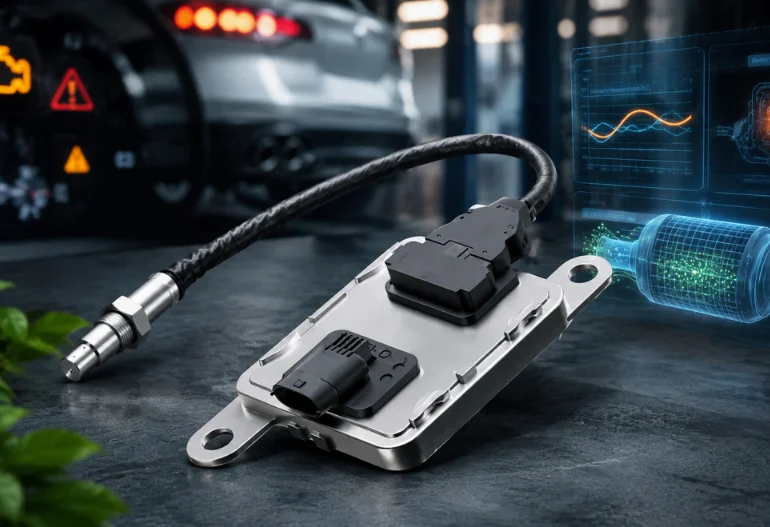
In modern vehicles, fuel consumption cannot be explained only by engine displacement, driving habits, or road conditions. Today, the engine control unit, exhaust emission system, SCR system, AdBlue dosing, DPF, EGR, and sensor technologies operate as an integrated system. When one of these systems fails to produce accurate data, the vehicle’s fuel efficiency, engine performance, and emission values may be negatively affected.
At this point, one of the most critical components is the NOx sensor. The NOx sensor measures the level of nitrogen oxides in the exhaust gas and provides data to the vehicle’s emission control system. This data is evaluated together with the SCR catalyst and AdBlue system, especially in diesel vehicles. So, does a NOx sensor failure affect fuel consumption? Yes, depending on the vehicle platform, engine software, and emission system structure, a NOx sensor failure may directly or indirectly increase fuel consumption.
How Is the NOx Sensor Related to Fuel Consumption?
The NOx sensor primarily measures the nitrogen oxide ratio in the exhaust gas. At first glance, this function may seem related only to emission control. However, in modern engine management systems, emission data is closely connected to the overall operating strategy of the engine.
The engine control unit evaluates the data received from the NOx sensor and manages processes such as the SCR system, AdBlue injection quantity, exhaust gas aftertreatment process, and, in some vehicles, combustion optimization. When the sensor transmits accurate data, the vehicle can maintain engine performance and fuel efficiency in a more balanced way while keeping emission values under control.
However, if the sensor produces incorrect data, the system may make incorrect decisions. This can lead to unnecessary AdBlue consumption, engine warning lights, power loss, protection mode, irregular operation, and increased fuel consumption.
Why Can a NOx Sensor Failure Increase Fuel Consumption?
There are several main reasons why fuel consumption may increase in the case of a NOx sensor failure. The first is incorrect data being transmitted to the engine control unit. If the vehicle’s control unit cannot accurately read the NOx level in the exhaust gas, it may attempt to operate the emission system on the safe side. In some vehicles, this may cause the engine strategy to operate less efficiently.
Another reason is the vehicle entering protection mode. As a NOx sensor failure progresses, vehicle performance may be limited. The driver may press the accelerator pedal more to achieve the same acceleration or traction. In practical use, this means higher fuel consumption.
In addition, a NOx sensor failure can trigger additional problems related to the SCR system, AdBlue dosing, DPF regeneration processes, and exhaust emission management. Especially in heavy-duty vehicles, commercial vehicles, trucks, buses, and fleet vehicles, such efficiency losses can significantly increase operational costs.
Is an Increase in Fuel Consumption Always Caused by the NOx Sensor?
No. An increase in fuel consumption is not always directly caused by a NOx sensor failure. Injector problems, clogged air filters, EGR failure, DPF saturation, turbo pressure issues, tire pressure, low-quality fuel, incorrect engine oil, exhaust leaks, or driving conditions can also increase fuel consumption.
Therefore, it is not correct to conclude that the NOx sensor is faulty simply because fuel consumption has increased. Professional fault diagnosis should be performed, fault codes should be read with a diagnostic device, live data values should be examined, and the emission system should be evaluated as a whole.
However, if the increase in fuel consumption is accompanied by the engine warning light, AdBlue warning, performance loss, emission system fault, or protection mode, the NOx sensor should definitely be among the components to be checked.
Fuel Consumption Symptoms That May Be Seen in NOx Sensor Failure
A NOx sensor failure can affect fuel consumption in different ways. The vehicle may consume more fuel than usual, long-distance consumption may increase noticeably, or consumption values may become unstable during urban driving. In some cases, the vehicle may not be able to maintain its previous consumption levels even at a constant speed.
This situation becomes even more critical for businesses managing fleets. A seemingly small increase in fuel consumption in one vehicle can create a significant monthly and annual cost difference across dozens of vehicles. For this reason, the NOx sensor is a strategic component not only for emission standards but also for operational efficiency.
Does a NOx Sensor Failure Also Affect AdBlue Consumption?
Yes. The NOx sensor is directly connected to the SCR and AdBlue systems. The sensor measures the nitrogen oxide level in the exhaust gas and helps the system perform correct dosing. When the sensor measures incorrectly, the vehicle may use either more or less AdBlue than necessary.
Irregular AdBlue consumption does not necessarily mean increased fuel consumption on its own. However, it may indicate an imbalance in the vehicle’s emission management system. Over time, this imbalance may be combined with performance loss, warning lights, protection mode, and additional service costs.
How Does a NOx Sensor Failure Affect Engine Performance?
A NOx sensor failure may cause a decrease in engine performance. Symptoms such as loss of traction, delayed acceleration, reduced torque, lack of response at high RPMs, or sudden performance limitation may occur. When the engine control unit detects a fault in the emission system, it may limit power in order to protect the engine.
In this case, the driver may use more throttle to maintain the same performance. This driving behavior also increases fuel consumption. Especially in loaded commercial vehicles, long-haul trucks, and service vehicles used intensively in urban traffic, performance loss can directly affect fuel costs.
Is It Safe to Drive with a Faulty NOx Sensor?
Continuing to drive with a faulty NOx sensor may seem possible in the short term, but it is risky in the long term. A sensor failure is not merely a warning on the dashboard. The emission system, AdBlue management, SCR catalyst, engine control strategy, and fuel consumption may all be affected by this issue.
If the fault is ignored, the vehicle may enter protection mode, emission values may increase, fuel consumption may rise, and additional costs may occur in other system components. Therefore, when a NOx sensor failure is suspected, professional inspection should be carried out, the source of the fault should be clearly identified, and, if necessary, replacement should be made with a high-quality sensor.
Does a High-Quality NOx Sensor Contribute to Fuel Efficiency?
A high-quality NOx sensor accurately measures the nitrogen oxide level in the exhaust gas and provides correct data to the engine control unit. Accurate data helps the emission system operate in a more balanced way. This may contribute to maintaining engine performance, managing the AdBlue system correctly, and keeping fuel consumption at a more controlled level.
When choosing a sensor, price should not be the only criterion. Measurement accuracy, durability, vehicle compatibility, high-temperature performance, electronic board quality, long service life, and production standards should also be considered. Low-quality sensors may appear to offer a cost advantage in the short term, but in the long term, they may result in repeated failures, incorrect measurements, and higher service costs.
Reliable NOx Sensor Solutions with MCT Technic
At MCT Technic, we develop solutions in NOx sensor technologies with a focus on high accuracy, durability, and environmentally friendly engineering. Our products are designed to contribute to the effective management of exhaust emission values, efficient operation of the SCR system, support of engine performance, and sustainable transportation goals.
MCT Technic NOx sensors respond to the needs of the automotive industry with their structure resistant to demanding operating conditions, high measurement accuracy, environmentally friendly technology approach, and reliable performance focus. From passenger cars to light commercial vehicles, from heavy-duty vehicles to fleet solutions, we continue to produce with our engineering strength to support the efficient operation of emission control systems across different areas of use.
Frequently Asked Questions
Does a NOx sensor failure increase fuel consumption?
Yes. A NOx sensor failure may cause incorrect data to be transmitted to the engine control unit, inefficient operation of the SCR system, performance loss, and, in some cases, the vehicle entering protection mode. This process may increase fuel consumption.
Should the NOx sensor be checked first when fuel consumption increases?
An increase in fuel consumption can be caused by many different factors. However, if the increase is accompanied by the engine warning light, AdBlue warning, emission system fault, or performance loss, the NOx sensor must be checked.
Does a NOx sensor failure affect AdBlue consumption?
Yes. The NOx sensor works in connection with the SCR and AdBlue systems. Incorrect measurement may cause increased AdBlue consumption or irregular dosing.
Does a faulty NOx sensor reduce engine performance?
Yes. Sensor failure may affect the engine control system. Loss of traction, weak acceleration, reduced performance, and protection mode may be observed in the vehicle.
Does replacing the NOx sensor reduce fuel consumption?
If the increase in fuel consumption is caused by a faulty NOx sensor or a related emission system problem, replacing it with a high-quality and compatible sensor may help consumption values return to normal.
Does a low-quality NOx sensor affect fuel consumption?
Yes. A low-quality sensor or one that is not fully compatible with the vehicle may perform incorrect measurements. This can cause inefficient operation of the engine and emission system, irregular AdBlue consumption, and increased fuel consumption.
Contact MCT Technic
For detailed information about NOx sensors, fuel consumption, emission control technologies, SCR systems, and automotive sensor solutions, you can contact the expert team at MCT Technic.
MCT Technic Sensor Inc.
Address: Yeşilköy SB Mahallesi, Istanbul Specialized Free Zone, İşbi Plaza No: 4/1, 34149 Bakırköy / Istanbul
Phone: +90 533 600 99 42
E-mail: info@mctsensor.com
Contact us for NOx sensor technologies, fuel efficiency, and environmentally friendly emission control solutions, and receive professional support for the most suitable solution for your needs.

