


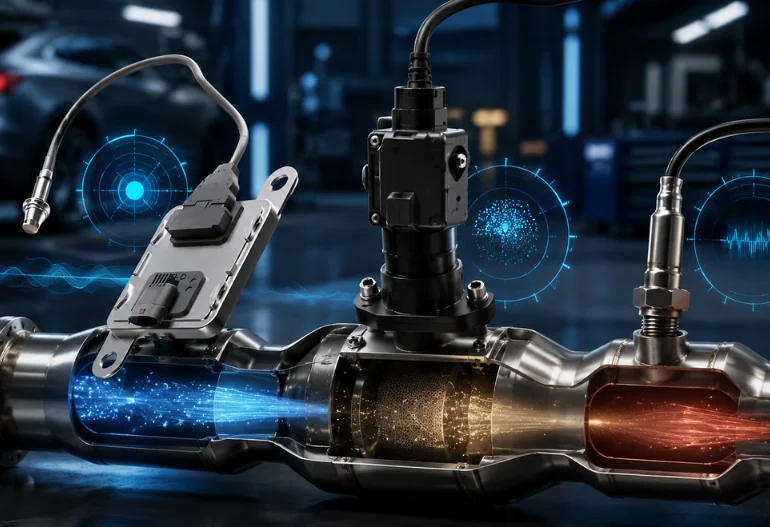
In modern automotive technologies, exhaust emission control is critical not only for complying with environmental standards but also for maintaining engine performance, improving fuel efficiency, and supporting the healthier operation of vehicle systems. At the center of this process are exhaust gas sensors.
The NOx sensor, PM sensor, and oxygen sensor are three important sensor technologies that perform different functions within a vehicle’s exhaust emission system. Each of these sensors measures different data, sends different information to the engine control unit, and operates at different stages of the emission control system.
So, what are the differences between a NOx sensor, a PM sensor, and an oxygen sensor? Which sensor measures what? Why are they used together in vehicles? In this article, we examine these three sensor technologies used in the exhaust emission system in a professional and clear way.
Why Are Exhaust Emission Sensors Important?
When fuel burns in vehicle engines, exhaust gas is produced. This gas may contain different components such as nitrogen oxides, particulate matter, oxygen, carbon monoxide, carbon dioxide, and hydrocarbons. Some of these components are considered harmful to the environment and human health.
Exhaust emission sensors enable these gases to be measured and controlled. The engine control unit analyzes the data received from the sensors and manages the air-fuel mixture, AdBlue dosing, SCR system, DPF regeneration, and exhaust aftertreatment processes.
For this reason, sensors are not merely measuring components. They are strategic parts that help vehicles operate in an environmentally friendly, efficient, and legally compliant manner.
What Is a NOx Sensor?
A NOx sensor is a sensor that measures the level of nitrogen oxides in exhaust gas. The term NOx is used to define nitrogen oxide compounds. In diesel engines, nitrogen oxide gases such as NO and NO₂ can form due to high combustion temperatures.
The NOx sensor measures these gases in the exhaust line and sends data to the engine control unit. This data is especially important for the SCR system and AdBlue dosing process. Based on measurements from the sensor, the vehicle optimizes AdBlue usage and the SCR system to reduce harmful nitrogen oxides in the exhaust gas.
The NOx sensor is a critical component, especially in diesel vehicles, heavy-duty vehicles, commercial vehicles, trucks, buses, and fleet vehicles. In these vehicles, keeping emission values under control is important both for legal compliance and operational efficiency.
What Is a PM Sensor?
A PM sensor is a sensor that measures the density of particulate matter in exhaust gas. PM stands for “particulate matter.” In diesel engines, soot and microscopic particles may be formed as a result of combustion. These particles are captured in the exhaust system by the DPF, also known as the diesel particulate filter.
The PM sensor monitors whether the DPF system is operating efficiently. It measures the particulate level in the exhaust gas and provides information to the engine control unit about filter performance. If the DPF is not functioning efficiently, if particulate density increases, or if a filter problem occurs, the system can detect this through sensor data.
The PM sensor plays an important role especially in vehicles equipped with a diesel particulate filter, in terms of environmental performance, emission inspection, DPF regeneration, and keeping particulate emissions under control.
What Is an Oxygen Sensor?
An oxygen sensor is a sensor that measures the amount of oxygen in exhaust gas. This sensor helps the engine adjust the air-fuel mixture correctly. It can be used in different system structures in gasoline and diesel vehicles.
Data from the oxygen sensor is evaluated by the engine control unit. Whether the engine is running with too much fuel, too little fuel, or close to the ideal air-fuel ratio is analyzed through this data. This allows fuel injection, combustion efficiency, and exhaust emission values to be managed in a more balanced way.
When the oxygen sensor does not operate correctly, fuel consumption may increase, engine performance may decrease, emission values may rise, and the engine warning light may come on. For this reason, the oxygen sensor is one of the most fundamental data sources of the engine management system.
Main Differences Between NOx, PM, and Oxygen Sensors
The most fundamental difference between these three sensors is the exhaust gas component they measure.
The NOx sensor measures nitrogen oxides. The PM sensor monitors particulate matter and soot density. The oxygen sensor measures the amount of oxygen in the exhaust gas and contributes to the management of the air-fuel mixture.
Their areas of function are also different. The NOx sensor is mostly associated with the SCR system and AdBlue management. The PM sensor is connected to DPF performance and particulate control. The oxygen sensor is used for engine combustion efficiency and fuel mixture control.
Another difference appears in their failure effects. In the case of NOx sensor failure, AdBlue warnings, SCR system faults, emission problems, and performance loss may occur. In the case of PM sensor failure, DPF warnings, soot buildup, regeneration problems, and increased exhaust emission values may occur. In the case of oxygen sensor failure, increased fuel consumption, irregular engine operation, and air-fuel mixture problems become more noticeable.
How Do These Sensors Work Together?
In modern vehicles, the emission control system does not operate based on data from a single sensor. The NOx sensor, PM sensor, and oxygen sensor work together to provide the engine control unit with data from different perspectives.
The oxygen sensor monitors whether the combustion process is efficient. The PM sensor tracks particulate density in the exhaust gas. The NOx sensor measures the level of harmful nitrogen oxides. The engine control unit combines this data to manage fuel injection, AdBlue dosing, the SCR system, DPF regeneration, EGR operation, and exhaust gas aftertreatment processes.
Thanks to this integrated structure, the vehicle maintains its performance while operating in a more environmentally responsible way. If one of the sensors produces faulty data, the entire emission management system may be affected.
Which Sensor Failure Is More Critical?
In fact, each sensor is critical within its own area of function. However, the impact of the failure may vary depending on the vehicle’s system structure. In a diesel vehicle equipped with an SCR system, NOx sensor failure can lead to serious emission and AdBlue problems. In vehicles with a DPF system, PM sensor failure can negatively affect particulate filter performance. Oxygen sensor failure can directly affect fuel consumption and performance by disrupting the engine’s air-fuel balance.
For this reason, accurate fault diagnosis is important. Instead of replacing parts only based on a warning light, fault codes should be read with a diagnostic device, live data values should be examined, and the exhaust emission system should be evaluated as a whole.
Why Is Using High-Quality Sensors Important?
Exhaust emission sensors operate under high temperature, intense gas flow, vibration, moisture, soot, and demanding driving conditions. Therefore, sensor quality is highly important in terms of measurement accuracy and durability.
A high-quality NOx sensor helps the SCR system operate correctly by measuring nitrogen oxide levels precisely. A high-quality PM sensor allows DPF performance to be monitored reliably. A high-quality oxygen sensor contributes to more efficient management of the engine’s air-fuel mixture.
Low-quality sensors or sensors that are not fully compatible with the vehicle may produce incorrect data. This may lead to increased fuel consumption, performance loss, unnecessary AdBlue consumption, DPF problems, engine warning lights, and additional service costs.
Reliable Solutions in Emission Sensor Technologies with MCT Technic
At MCT Technic, we develop high-precision, durable, and environmentally friendly sensor technologies for the emission control needs of the automotive industry. With our engineering approach in NOx sensors, PM sensors, and oxygen sensors, we aim to help vehicles operate more efficiently, reliably, and sustainably.
In our product development processes, we prioritize measurement accuracy, long service life, vehicle compatibility, high-temperature resistance, quality standards, and an environmentally friendly technology approach. From passenger cars to light commercial vehicles, from heavy-duty vehicles to fleet solutions, we offer solutions that add value to emission control systems across different areas of use.
At MCT Technic, we do not only manufacture sensors; we also contribute to the sustainable future goals of the automotive industry with our engineering strength.
Frequently Asked Questions
What does a NOx sensor measure?
A NOx sensor measures the level of nitrogen oxides in exhaust gas. This data is used in SCR system management, AdBlue dosing, and emission control processes.
What does a PM sensor do?
A PM sensor monitors particulate matter and soot density in exhaust gas. It is especially used to monitor whether the DPF, or diesel particulate filter, is operating efficiently.
What does an oxygen sensor control?
An oxygen sensor measures the amount of oxygen in exhaust gas. The engine control unit uses this data to optimize the air-fuel mixture.
Are a NOx sensor and an oxygen sensor the same thing?
No. A NOx sensor measures the level of nitrogen oxides, while an oxygen sensor measures the amount of oxygen in exhaust gas. The values they measure and their functions in the system are different.
Are a PM sensor and a DPF the same thing?
No. The DPF is the filter that captures particles in exhaust gas. The PM sensor measures particulate density and helps monitor DPF performance.
Can sensor failure increase fuel consumption?
Yes. If one of the NOx, PM, or oxygen sensors produces faulty data, it may affect the engine management and emission system. This can lead to increased fuel consumption, performance loss, or system warnings.
Which sensor failure triggers the engine warning light?
Failure of all three sensors may cause the engine warning light to come on, depending on the vehicle system. For an accurate diagnosis, fault codes must be read using professional diagnostic devices.
Contact MCT Technic
For detailed information about NOx sensors, PM sensors, oxygen sensors, exhaust emission systems, and automotive sensor technologies, you can contact the expert team at MCT Technic.
MCT Technic Sensor Inc.
Address: Yeşilköy SB Mahallesi, Istanbul Specialized Free Zone, İşbi Plaza No: 4/1, 34149 Bakırköy / Istanbul
Phone: +90 533 600 99 42
E-mail: info@mctsensor.com
Contact us for emission control technologies, environmentally friendly sensor solutions, and automotive engineering systems, and receive professional support for the most suitable solution for your needs.

